
I never read comic books as I kid but as a teen my mother introduced me to Raw, edited by Art Spiegelman. We had two issues as reading material in the first-floor bathroom. A piece by Richard McGuire that eventually became Here (see below) really struck me, and years later (2002 or 2003?) I was gratified to hear that it had also made a strong impression on Chris Ware. At a talk in Chicago, Ware discussed how the seven pages of “Here” in Raw had showed how time could be handled in a way that opened the rigid panel format. I also read Maus by Spiegelman in college on my own and tried to convince my concentration camp survivor professor that it really needed to be included on his Holocaust in Fiction syllabus (he was more than skeptical of a comic book about the Holocaust). Around the turn of the century I read and loved Ware’s Jimmy Corrigan, which at the time seemed like hearing Hendrix in the late ’60s reinvent the electric guitar, a total breakthrough after which things would forever be different. I read all those above before I started posting reviews on Goodreads in 2007. Below are impressions of most of the graphic novels I’ve read since then, presented in the order I read them, an asterisk before the title of those that are especially recommended. I’ll continue to add to this over time as I read new ones — I usually return to the genre every few years in the middle of winter, so it’s about time to see what I’ve missed recently. Send recommendations if you’ve got ’em. (Note that I didn’t include Ware’s Building Stories below because, although I own it, I don’t think I’ve ever actually read all of it, in part because much of the text is too small to decipher even with reading glasses — maybe I’ll try it again if I acquire a magnifying glass.)

*Asterios Polyp by David Mazzucchelli
“Wah,” I said aloud when finishing this. “God. Lovely. Really great,” I also said. Unputdownably beautiful. A blatantly philosophical, simple love story. Vivid characters. Funny. Touching: in fact, it successfully revealed the presence of my heartstrings—sentimental loon I am not, but I definitely felt something pull in the vicinity of my chest region toward the end. Sort of like Jimmy Corrigan: The Smartest Kid on Earth by Chris Ware meets a way more formally sophisticated The Elegance of the Hedgehog by Muriel Barbery, spiked with references to the Odyssey, apparently (so sayeth the blurbs I just read). The blurbs also say it’s “difficult,” but the time shifts won’t be a problem if you’re semi-accustomed to Faulkner and Chris Ware—handled really fluidly and elegantly here, with the various temporal threads color-coded (eg, yellow pages indicate a dream sequence) the way Faulkner originally wanted for The Sound and the Fury. Will lend my copy to my mama and will read again when she returns it. Perfect deep winter company. Thanks to Mr. Vollmer for the rave (“not eye candy—this is eye crack”). But how’d I just find out about it a few days ago?! What else is similarly supergood and lurking around the corner?

Fun Home: A Family Tragicomic by Alison Bechdel
Read this in one Saturday-night-at-home sitting (and undercovers-in-bed reclining). Had to finish it once I hit page 100. Perfect balance of telling (in the text) and showing (in the drawings). At times I thought it was almost exposition-heavy, but the straight-forward drawings convey a good deal about the characters, the setting, the emotions. Amazing how it so often streams its story through a Proust, Joyce, Homer filter (it’s Colette and Kate Millet who really work for her) without getting annoying. (And by successfully associating itself with canonical greatness she raises the bar for her story so it might one day assume canonical greatness, as well?) A funny moment for me when she’s reading at her college library in a womb chair and I said hmmm I wonder if she went to Oberlin? I googled the author and, yep, graduated in ‘81. A few pages later she depicts Tappan Square and Wilder Bowl. OF COURSE SHE WENT TO OBERLIN. Anyway, an enjoyable, moving, engaging, formally grounded literary memoir of the graphic sort. (Thanks to everyone who’d rated it already and made me feel like a freak for not having read it yet.)
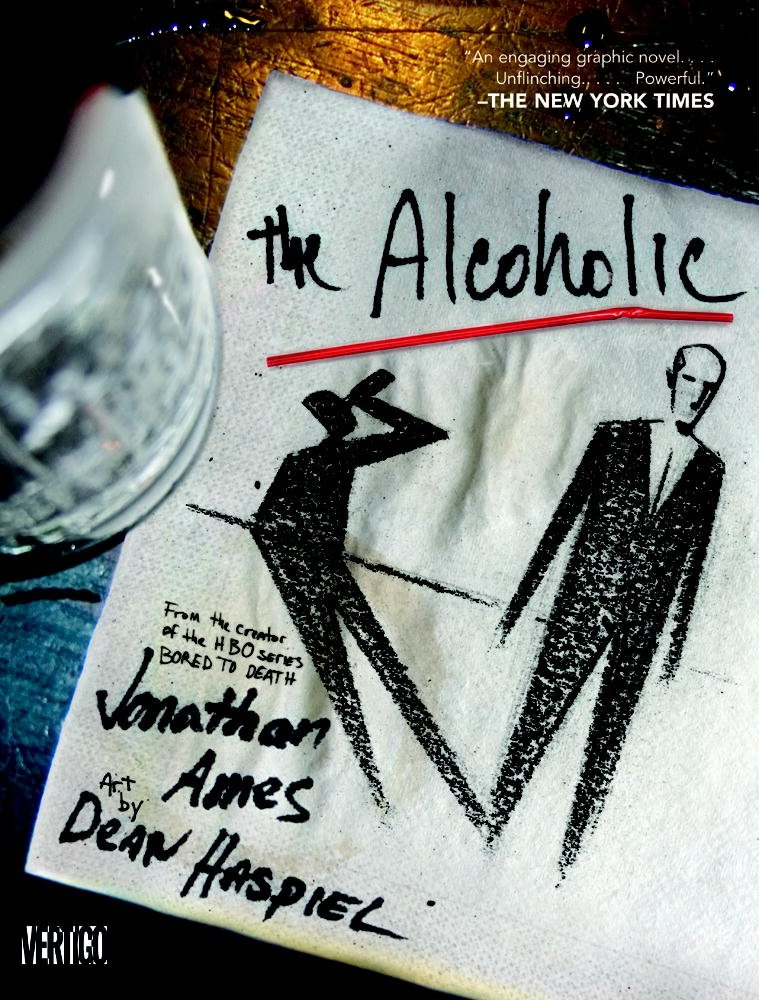
The Alcoholic by Jonathan Ames
All the classic Ames themes, plus Monica Lewinsky eating a sausage at Velselka. More sad and confessional than funny. I have one of those fringe diagram printouts somewhere . . .

Bottomless Belly Button by Dash Shaw
Surely the fastest 720-page read in the bookstore. The faster I moved through it, the closer reading came to watching a film, sort of like a flip book. Maybe reminds me of a sad quirky not-so-funny indie comedy crossed, at its best, with some Ozu-y sweetness? By which I mean it’s totally in favor of affectationlessly portraying minor life moments until they seem to achieve “poignancy” and therefore deserve an elevated term like “quotidian” instead of common/dull? The drawings aren’t close quality-/complexity-wise to other leading graphic novels I’ve seen but crude simplicity lets it accelerate and sometimes even seem to take off, like a chair with tons of helium balloons tied to it. One LOL pretty early on. As such, I grant it an affectionate three stars and look forward to maybe “watching” it again one day.

Syncopated: An Anthology of Nonfiction Picto-Essays by Brendan Burford
The best (only) anthology of essayistic comics I’ve ever read. No real clunkers. Sometimes “meh” form- and content-wise, other times more interesting (graffiti artists in old train tunnels under Riverside Drive park; a profile of a long-time Washington Square chess player; the Tulsa race riots). Most were straight-up and reliable but often seemed thin (unlike essays in the New Yorker, per some reviews/blurbs). Not sure if the form works as well for short essays as it does for extended non-fiction, or even shorter fictions? Worth a look but hard to jump up and down about short “picto-essays” about Native American identity; adopting a Chinese infant; the guy who came up with the eight stages of child development; drawings of Washington Square Park or NYC subway buskers (yawn); or an appreciation of what it takes to bale hay. Also, maybe seemed a little too NYCentric? Perfectly adequate and original but nothing to get all evangelical about . . .

*The Acme Novelty Library #20 (“Lint”) by Chris Ware
A self-contained 80 or so page chapter from a “ridiculously long” work yet to be finished or collected but serialized lately in these gorgeous full-color hardcovers. This one presents representative days in the difficult life from birth to death of this not-so-sympathetic Nebraskan fella, organically/inventively structured and elaborated in Ware’s particular visual language that allows for so much association, imagistic representation of thought, and ultimately a degree of empathy for the aforementioned not-so-sympathetic fella. Amazing, as expected. Read in a two-hour sitting. Four stars only because I’ll probably give the complete longer work five or six. Highly recommended and probably infinitely re-readable as is.

BodyWorld by Dash Shaw
Sometimes really beautifully expressive—a mix of photoshopped drawing and smeared paint—but otherwise, like Bottomless Belly Button, an apparently rushed graphic “novel” entertainment. Unlike other leading brands in the genre that pretty much work on the same level as non-pictorial fiction, Shaw’s stuff seems way less concerned with getting all philosophical and profound and poignant (and thereby also all interesting and awesome). Instead, this story and the characters seemed not so developed, semi-existing in a superficially deployed future high-school world in which there’s a stock alien plot involving a weird empathy-enhancing drug that leads to cool moments visually, sure, but “visually cool” also seems like the edge of this one’s ambition. At first, it seemed as ambitious as the other leading graphic novels, but in the end, thematically, emotionally, psychologically—artistically—it seemed “cooler” than the others (“cooler” in quotes to suggest that I have more respect for the other books). Worth looking at it if you see it somewhere—worth the three hours it took to look at what seems to have taken a few years to make—and definitely a visual improvement over Bottomless Belly Button, if not much of a thematic improvement, I guess.

The Acme Novelty Library #19 by Chris Ware
Self-sufficient sci-fi layercake. First comes a pulpy outerspace adventure, then it’s all about how the young Rusty Brown became interested in science fiction, finished with a sci-fi textual short story by Rusty Brown. Not quite at the level of #18 or #20 but still wholly worth reading. Surprising: occasional tiny, sexually explicit/suggestive images. I can see how some get tired of Ware’s loveable losers. The girl in #18, young Rusty in this one, and Jimmy Corrigan are all cut from the same Charlie Brownian cloth, except the girl in #18, young Rusty, and Lint all turn to art in response to a sense that the world’s rejected them. The graphic approach, more than the characters, is what does it for me. This one seemed a bit more traditionally framed than the wholly Ware-an whole-page cycling schematics of association in Lint and #18. 4.1 stars maybe?

*The Acme Novelty Library #18 by Chris Ware
Sheer Ozu-y goodness in this one. “Parent’s house” appears twice, the only real flaw, other than maybe excessive (very small) text. Otherwise, Ware’s quest to correct for decades of action-heavy cartooning with wholly original, imaginative, purposefully quotidian assaults on readerly eyes and hearts continues. As always, amazing stuff. Totally individuated art, with nods to Proust and Ozu and Perec’s Life: A User’s Manual here and there.

I Will Bite You! and Other Stories by Joseph Lambert
Beautifully made book, short graphic stories, mostly traditionally structured, playful and menacing, kids running around causing havoc, wielding their scribbled dialogue balloons like weapons. Yellow the primary color. Much eating of people, places, moons. A great retelling of the tortoise and the hare tale, recasting them as drummers—”turtle keep it steady” shall hereafter be the motto whenever I sense the least shred of schadenfreude playah hatin coming on. Overall, a fine little addition to my small yet growing collection of comics for big old kids.

*Monsters by Ken Dahl / Gabby Schulz
Five stars? Really? Really? For a freakin’ comic about the author/artist’s experience with herpes? Indeed. There’s enough humor and pathos and artistry and anti-everyone sweetness and STD information to make this book wholly individuated, informative, entertaining, emotional, eye-catching reading. Very talented deployment of drawing, characterization, storytelling oomph, thematic/existential heft, balance of dramatization and exposition, distortion of frames to match the author’s psychic sense at the time. But mostly it’s informative and funny and I couldn’t stop reading till it was done. Sort of like Maus for my generation? OCD re STD = five stars for me. (Not because I have herpes. Not that I’m aware of at least.)

Welcome to the Dahl House: Alienation, Incarceration, and Inebriation in the New American Rome by Ken Dahl / Gabby Schulz
Good clean leftist sociocultural critique fun, at its best when venomously shouting about post-9/11 Bush-era hypocrisies. LOL funny (the history of zines; the skillshareabout frozen bananas) and surprisingly insightful (aboard a flight on the 2nd anniversary of 9/11) and evocatively detailed (the tang left on one’s palms by those metal ropes after swinging on an outdoor swing set). The author/artist is my age exactly so I catch the Suicidal Tendencies/JFA jokes. I’ll definitely read more Mr. Dahl. When’s his next one come out?

Stitches by David Small
Such strange compressions of time: 24 years of the most significant moments in the author’s life laid out in comparatively spare, sane, elegant, mature B&W drawings (compared to the work of many other leading graphic artists) over 329 pages that surely took years to complete, read in an “enjoyable” hour, immersed in that sort of cinematic bookishness that comes from turning pages so much more quickly than those covered in text. A great passage of pages where the kid-aged author dives through a drawing and down a tunnel through the floor that leads to a secret hideout of cartoon mice and heroes and such. The B&W drawings work well to depict thriving old Detroit and domestic tension expressed as clenched silence. As fiction, the story’s a bit much in terms of ‘60s-era Midwestern repression but thankfully this is memoir, another coming-of-age portrait of the artist in several hundred frames. It’s affecting but sometimes it may have poured too much poignancy (pages of rain) on me. It’s novel length but there’s nothing particularly novelistic about it. It feels more like a story, in terms of length and depth. But still I’d recommend it for brief immersion in the sort of characteristically sucky childhood that—without fail, apparently—turns a child into the sort of artist who eventually publishes an excellent (if in this case at times a somewhat hasty/thin-seeming) pictional memoir.

Are You My Mother? by Alison Bechdel
A self-consciously forced “meta-book” follow-up to Fun Home. Another in the growing list of books about writers trying and mostly failing to write books. Didn’t really “cohere” for me. Instead of a literary side-commentary complement to the story of her father, in this she spins psych nuggets to assay her mother, although it’s not really about her mother of course, and what’s dredged up isn’t juicy enough to activate voyeuristic impulses? “Never again psychology!” Kafka shouts in one of his diaries. The study of Psychology with a capital P like that rationalizes in a way that seems out of place in art? Its all-encompassing filters are the antithesis of psychologically charged stories that come to quite possibly identical realizations via unique routes? Or, to put it less clearly, in a more muddled fashion: rational analytic filters for heart mush and mind melt reduce the bloody muddy eddy of life to unsexy non-art? This one’s formally more varied than her first one in a way that I guess corresponds to hectic thematic and temporal complexities of the story, but maybe I simply preferred her first book’s steady panels? Also, the drawings probably aren’t as interesting as that of other leading graphic novelists, which isn’t a fair criticism really?
In general, although it had a few shining moments, I didn’t quite “cathect” with this one’s not so graceful, overtly rational web, I respect the attempt to write a memoir about writing a memoir about mom after writing a memoir about dad, and I respect the attempt to represent the psychoanalytic complexities with the various threads knotted herein with her mama’s not-very-overbearing apron strings, but again I didn’t latch on, so I didn’t feel sweet milky nourishment fill my readerly gullet. I also didn’t necessarily like the presentation of the author in this one as much? Something to do with the ear buds she wears while on the phone with mom? Something to do with her contorted mid-analysis postures? Or maybe I found the conceits of therapy sessions and talks on phone with mom, intermixed this time with unnatural/forced psychological theories, not all that narratively compelling?
I look forward to reading her stuff in the future (assuming she has relatives to write about?) but didn’t feel like this one worked for me. Note: started reading this after newish drunken neighbors woke us at 4 am on St. Patrick’s Day Eve—started it well before dawn and finished around 11 am—so please realize that what’s above is the product of a fuzzier than usual mind (although excessively caffeinated, as always). Clicked three stars at first, ye olde 2.6767 stars rounded up, but then thought it wasn’t fair to books for which I’ve recently rated my reading experience “three stars” (the similarly multithreaded Carrie).

Big Questions by Anders Nilsen
I love these enormous graphic novels that almost become cinematic as you turn several hundred pages. Such a beautiful physical object with thick sheets and a thick spine and overall serious rectangular heft contrasted by the open white expanse inside, a desolate territory offering a house, an old woman, an idiot, a plane that crashes into the house, the pilot, plenty of wonderfully named finches, an innocuous old snake, an owl, an underground afterworld, a bunch of catty crows (also wonderfully named), a pair of swans, and I think that’s it. The story is totally organic and light, somehow despite morbidity and bursts of violence. Despite the title, I didn’t really feel like this was as explicitly philosophical or idea-ist as most graphic novels I’ve read. It also, thankfully, wasn’t as sad (I’m thinking Ware). Definitely loved time spent reading it—was certainly charmed but maybe wasn’t totally rapt or moved. Or maybe the enervating idiot and the mean-spirited pilot seemed too one note for me? Maybe if they were more human I would have raved a bit more? Anyway, absolutely an awesome Xmas gift for all your friends who read these fancy picture books.

Ant Colony by Michael DeForge
LOLs early on and full-page Boschian panels of battles with red ants. The story broke apart but not the art. I met the author a few years ago at a book release party for one of his friends who played in a band with a friend of mine. Of all the books in the store devoted to comics and graphic novels etc, I was most attracted to one that turned out to be his. Been meaning to look at his stuff ever since. His drawing is unmistakably his own at a glance.

*Book from the Ground by Xu Bing
Absolutely original graphic novel composed entirely of emojis and/wingdings or whatever. A very simple day in the life of a young white collar worker waking up, going to the bathroom—oh damn it looks like all the emoticons I embedded in a quick little review of this didn’t come through and the whole thing was truncated. Anyway, a charming little tale told in a new way that can probably be read by anyone regardless of language—the author is Chinese. I only failed to catch the drift of something once or twice. I’m sure there will be more of this sort of thing as the emoji options evolve.

*Here by Richard McGuire
I’ve known the basis for this book since my mother gave me her copy of Raw (Volume 2 Number 1: Open Wounds from the Cutting Edge of Commix) that included the seed for this, which blew my mind as I read it on my parents’ downstairs toilet while home for Xmas in 1991 to be exact. At grad school I presented a Xerox of the Raw pages in Edward Carey’s seminar on the use of images in fiction after hearing Chris Ware talk about McGuire’s piece in Raw #2 as the temporal inspiration for his work, how it blew open the regular conventional comic book frames and presentation of time. Although I loved this, it felt like an extrapolation that came a little too late, the innovator’s attempt to match the work of those he later influenced? That is, it’s difficult to read this now without thinking about Chris Ware, as though Ware influenced it in a backwards Borgesian sense. It’s a totally lovely way to spend an hour, though. Highly recommended to anyone interested in graphic novels or the telling of time in storytelling of any sort.

*My Favorite Thing Is Monsters, Vol. 1 by Emil Ferris
Greatest graphic novel I’ve read in a while, since Asterios Polyp probably — but to talk about it only in terms of “graphic novel” reduces it. It’s just a beautiful, intriguing, meaningful, surprising, world-evoking, creative, moving, masterful story, up there with the finest administration of story in any medium. My mother gave me her copy of this about a year ago and I read the first few pages but put it down, unable at the time to read this as I walked to work on warm days since it’s too heavy and large and at times dense with text. Returned to it recently and read it with wide-open eyes that seemed saturated by the colored ink on these high-quality heavy pages. Excellent winter reading. Excels at characterization, plot propulsion, suspense, mystery, heft, and generosity of the artist/writer’s effort. Feels like a monumental, wholly worth it enterprise. Very much looking forward to Vol 2 coming later in 2020 . . .

Crawl Space by Jesse Jacobs
Writing this after blazing through in maybe a half an hour at most — a first of many reads most likely. Psychedelicized high-school experience, complete with the rager that wrecks it all, but abstracted to a realm of pure shapes and colors (the ideal essence of visual art). As much “The Lion, The Witch, and The Wardrobe” as that Peter Fonda movie “The Trip.” Squirmy, brilliant in the bright and British “smart” sense, sort of like the textual equivalent of a Starburst, with a spiritual side. Loved it — and will now acquire something else by this author.

*Good Talk: A Memoir in Conversations by Mira Jacob
Dramatizes the psychosociocultural complexities of existence for an Indian-American woman from New Mexico now married to a Jewish documentary filmmaker and their young mixed son who tends to ask questions about the vileness he sees and hears on the news these days. An often moving, often humorous illustrated/graphic memoir about hope and progress and morality. Sort of teared-up at its climax, a spread showing a long quotation from Obama about the audacity of recognizing the failures of the past and progressing from it. A graphic memoir but the emphasis isn’t really on the art, although its pages of identical or nearly identical illustrated images over photographs and dialogue bubbles are generally appealing and often beautiful. The emphasis is more on conversations (see the subtitle), and like most graphic novels it’s quick, easy, engaging reading — in this case, it’s wholly enjoyable, perfectly sequenced and paced, with enough levity and asides to balance confrontations with racism (best when super-subtle and/or from within her own culture — ie, she’s not “fair” enough to attract a suitable marriage match) and generalized ignorance in the US about subcontinental Indian culture, most dramatically and especially after 9/11, mistaking her for Middle Eastern etc.
I met the author in the late-’90s at a Tompkins Square area apartment when she was dating a college friend (she also went to the same college although I didn’t really know her there) and I was aware of her and may have talked with her once or twice when she ran a reading series in Williamsburg I sometimes attended nearly twenty years ago. I read the college parts therefore and early NYC bits with special interest, wondering if one of the white boyfriends was the guy I knew. But I’m sure that without preexistent familiarity the story and its presentation will make you feel like you know the author and her family in the end. It absolutely particularizes and presents its wholly contemporary, wholly AMERICAN reality in a way the reader lives and roots for and ultimately has hope for. I don’t necessarily believe that art needs to be “relevant” and purposeful, a force for good and justice and the ideal American way, but if you’re looking for something that meets that description and can be read in a handful of engaged, enjoyable hours, I definitely recommend this.

*Rusty Brown by Chris Ware
Awed again as always by Ware. For some reason I had lower expectations for this, maybe from some exposure about ten years ago to Rusty Brown pages that didn’t quite do the trick for me, or maybe from mixed reviews and not much on my radar raving about it elsewhere online. After the first twenty pages into it I actually considered putting it down. Text in the dialogue bubbles in the parallel-story panels along the bottom margin was nearly indecipherable even with reading glasses. It reminded me why I quit reading Building Stories when it came out. I just couldn’t read it! The print was too often too small, but that was before I started wearing basic 1.5 magnification reading glasses that made everything so much more legible. This time around, with glasses on, I asked wife if we had a magnifying glass (we did not). But after a while the lower panel merged with the main story and in the end flowed through its handful of sections (one of which I read nearly in its entirety a few years ago as Lint).
In general, the single lingering impression is awe as well as recalibration of my understanding of what grand fulfilled ambitions looks like. I also have a really strong desire, on behalf of the author and publisher and basic readerly intelligence, to right the wrongs in a few of the well-liked reviews. First of all, it’s not “a day in the life” — to discount or not notice the passage of time, particularly in the Lint section (each page equals a year in his life) but also the last section or the section dramatizing a sci-fi story set on MARS, is straight-up asinine or at least ignorant/blind when it comes to determining narrative structure.
The second thing is the criticism that this is about “toxic masculinity” — JFC, the male characters are all lonely, wounded, trying to do good but often repeating learned behaviors or letting themselves be led often by worst instincts into not very admirable situations or behaviors. It’s highly detailed shorthand glimpses into representative/significant moments that evoke the complexity of existence, expressed in a wholly ambitious, totally individuated, completely at the forefront of its genre, moving, beautiful, episodically and associatively driven (ie, not driven by mutually conflicting sets of desires and/or a series of obstacles to overcome — AKA “plot”). It’s subtly Faulknerian, maybe, at least with the final story from the perspective of the black lower-school teacher Joanne Cole, a la Dilsey in The Sound and the Fury. Jordan Lint’s first name seems to go back and forth between Jordan and Jason (Jason is the worst member of the Compson family). Rusty with his Supergirl doll is sort of like Benjy, I suppose, with his narcissus — pretty innocent. But the analogy breaks down there.
In general, it’s a hyperstylized view into these lives that have one foot in mid-’70s Omaha, Nebraska and the other in a Ware universe that always errs on the side of dashed hopes, poignancy, sorrow, loneliness (never a positive sense of solitude), at most interspersed with a sense of beauty and grace and temporal mystery and divine enormity thanks to the author/artist’s formal mastery. I’ll soon go back to Building Stories with my glasses this time — and may try to read this again this year. It’s apparently the first installment. I look forward to the rest whenever it arrives. The author expects to live until 2050 per the dust-jacket, which I had off my copy and then savored as the perfect finisher.

Safari Honeymoon by Jesse Jacobs
Read this in a single sitting. So good. A couple and their guide on safari in a remote jungle populated by insidious parasites and beasts and smiling humanoid creatures (albeit called “monkeys”) with extra-long limbs that communicate silently via antennae. Two legit LOLs and general amusement and appreciation throughout. Read this after Crawl Space but I’d recommend reading this one first, not that it really matters though. You’ll enjoy both if you have an inkling for semi-psychedelic, surrealistic, alt-real, amusing, elaborately creative, storytelling action in ink.

Berlin by Jason Lutes
Pretty sure this is the first hyped/lauded graphic novel I’ve read that failed to at least meet my expectations. It’s long, sure, and it juggles a ton of characters, including a bisexual woman who’s with a woman who dresses as a man, it represents political and class conflicts leading up to the rise of the Nazis, the story moves well for being so populated and fractured, there were moments of beauty and poetry and excitement, sure, but I ultimately felt like I was reading a comic book about late-’20s Berlin, unlike when reading Berlin Alexanderplatz or Zwieg or Erich Maria Remarque et al — or more so and more importantly I’ve become accustomed to and expect more of a visual treat thanks to formal unconventionality and a sense that the pages saturate my sight with movement and color. In this, the conventional panel structure, the way so many characters seemed to have a similar facial shape with the same strong jaws, the fight scenes complete with BAMMMM BAAASH, the way the characters seemed animated by the results of research and the mechanisms of history more than intuition into their individuated humanity, the requisite cameos by Josephine Baker and Hitler, all combined for relatively enjoyable easy reading but not something particularly interesting or innovative or exciting, especially compared with masterworks I’ve read recently by Chris Ware and Emil Ferris, or even the slender squirmy nutso entertainments by Jesse Jacobs or Mira Jacob’s comparatively way more visually appealing memoir. Again, I generally liked reading it but its sexual, racial, political, and religious content often seemed forced and rote. I appreciate and admire the author/artist’s talent and ambition but ultimately feel like the final product fell short for me in terms of audacity, individuation, and execution.

Absolute Daytripper by Gabriel Bá, Fábio Moon
Very glad I invested in this (it’s not cheap) — beautifully drawn, poignant, significant, even if at first it seemed a little more like a comic book than a proper high-brow graphic novel. The frames seem to open up as it proceeds. Solid characters and always fun midway through a chapter to remember that the character would die soon. Depicts artsy, well-educated, well-off Brazilians, which is sort of refreshing since I imagine the whole country isn’t like City of God. Not quite Asterios Polyp, or My Favorite Thing Is Monsters or the best Ware but up there. Vibrant, imaginative, moving, evokes that peculiar pleasurable feeling of simultaneous reading and watching that only comes with good graphic novels.

Night Animals by Brecht Evens
Two pleasing, lush blends of Big Mouth and Where the Wild Things Are, for adults.

*The City of Belgium by Brecht Evens
One of the most visually impressive graphic novels I’ve read. Up there with the grandmasters. As with Night Animals, the short romp I read before this by Evens, this is a wild rumpus involving young adults out on the town, at first at a surreal urbane cafe and then, at different times in the night, all taking the same taxi, driven by a confabulatory driver, to various nightclubs. The colors are intense, flowing, liquid, not such things as frames although sometimes the pages are stripped down to simply colorful figures conversing. Lots of small text. Inexhaustible in its details, for example the spread with all the interlocking names of bars and nightclubs. Impossible to see it all, a quality I’ve only really registered a few times (Chris Ware). The primary characters aren’t particularly sympathetic but they’re sufficient as buoys in the polychromatic whitewater of the pages. Felt like it was maybe a little long but appreciated its midsection by the end. Will probably acquire everything else available by Brecht Evens.

Panther by Brecht Evens
Enjoyable. A young girl with her pretend friend, a lovable panther. Visually impressive but a little more straightforward and PG than the two other Evens books I’ve read.

My Favorite Thing Is Monsters, Vol. 2 by Emil Ferris
Inflated the all-important star grade because four stars seemed unfair considering the quality of the drawings, the complexity of the characterization, and the evocation of late-’60s Chicago. Much of what I wrote about the first volume still applies to this one. I read about 60% of this on a long lazy Sunday, a perfectly enjoyable, engaged reading session, although it’s not quite like some graphic novels that seem to achieve a cinematic lift-off effect after a while. There’s a lot of text, it’s not always clear in which order the text should be read, several knotty narrative threads, not quite clear all the time exactly what’s going on, all of which is fine and makes sense since the book is supposedly the notebook of an adolescent narrator, coming to terms with her artistic abilities and sexuality after her mother’s death, a young teen who doesn’t quite have a handle on everything going on with her brother and neighbors, the shady colorful world of adults. Excels at semi-monstrous presentation of neighbor weirdos in late-’60s period dress as well as reproductions of famous paintings at the ICA and elsewhere. The full-page crosshatch-happy color drawings throughout are out-of-control excellent. Some pages are also rougher, scrappier, in black and white, more like preliminary sketches, a texture I don’t remember in the first volume. Generally, another excellent unique elaborated satisfying installment. Long-awaited (the first expected publication date was in 2020) and thankful it’s finally arrived.

Killing and Dying by Adrian Tomine
Watched Shortcomings recently and liked it well enough that I thought I’d read the original to see how it’d been adapted but wound up ordering this one instead, which I liked well enough with reservations. “Go Owls,” the ending at least, I laughed aloud when what I suspected might happen at first actually happened in the end. It was perfectly surprising and inevitable, as they say, and so damn poignant for the dude — elevated spirits brutally dashed, in the best way. Really good. The title story had its moments, too, the first standup bits. The other stories I read, semi-irritated with the stereotypical sad-sack focus of the form, also wondering about something maybe kinda condescending/classist in play about the economic strata of the characters, compared with the likely situation of the Brooklyn author artist and the likely readers of a graphic story collection (the app autosuggested “novel” but this is a collection of short stories). If these stories were textual I wonder how I’d feel about them? They’re super-straightforward, well-done, crisp, taut, sure, but also so framed, so caught within the confines of the squares, the right-angled borders of the animating instinct and the same-old emotional expectations of the medium. But generally enjoyed reading it over the course of an afternoon hour, reclined on the porch on the most beautiful Labor Day in memory.
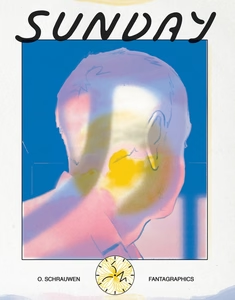
Sunday by Olivier Schrauwen
Acquired this after Chris Ware, on the Beyond the Zero podcast, recommended this as probably the greatest graphic novel of the past 10 to 20 years. Liked reading it, looking at it, sure! Mr. Ware may have hyped it but it’s definitely one of the more visually appealing graphic novels, with ambitious, original, yet intuitive storytelling. Reminds me somewhat of the author’s countryman Brecht Evans (The City of Belgium, eg), albeit more washed than bright colors. The linear day-in-the-life format gives the author a lot of leeway, although through some of it I was somewhat frustrated with the central character, his level, common thought processes, masturbation, drinking etc. Interesting that he’s a font maker but overall the author could’ve chosen someone else’s Sunday to depict? Perfect for end of the year, darkest week, pre-Xmas reading, usually the time I turn to these fancy high-art adult comix.

The Wrong Place by Brecht Evens
Evens’s graphic novels are up there art-wise with anyone, descended from Henri de Toulouse-Lautrec’s Moulin Rouge-type saturated palette (green faces, rose and plum, water-stain shadows), transported in time and space to relatively contemporary Brussels or Paris, and this one coheres story-wise maybe a little more than the others of his I’ve read (Panther, City of Belgium, maybe another short one). A story of a friendship between the super-humanly charismatic/omni-attractive stripe-shirted Robbie and his old pal Gary, solely cast in gray, balding, trying his best but generally inhibited and simply nowhere near as cool. Evens crushes kinetic colorful carnivalesque party scenes, and this one features many such pages, as well as probably the greatest sex scene (two consecutive spreads) I’ve seen in a graphic novel, like reading The Joy of Sex on psychedelics. That scene arrives before a touching scene in which the two old opposite-type friends meet up and share a moment before battling it out with some old fencing equipment. The pace of the story in its second half really accelerates and achieves quasi-cinematic page-turnery immersion. Four stars only because Evens’s narrative scope/storytelling ambition in this one, although a simple enjoyable story, doesn’t quite match the level of his artistry, and although I can’t quite remember City of Belgium all too well, I do know I rated that one — a later, more evolved, more ambitious, more substantial project — five stars.

*The Jellyfish King (El rey medusa) by Brecht Evens
Masterwork first installment of a series about a young artist boy (“puer universalis” per his father — “universal boy”) and his eccentric father who dresses all in yellow (father-son dynamic reminded me of Curious George and his yellow-hatted friend), including a face mask of some sort, who’s slowly and ambiguously revealed either to have schizophrenia or — because POV is the child’s — to actually be fighting for the Alliance against the Directors or Leaders (“Dirigentes”) or Skulls. In the Spanish translation I read, that last term for the bad guys is spelled “Skouls,” which seems like a blend of “Skull” and “Skoal,” which makes sense since the ending (not really a spoiler) dissolves into a series of toasts to eccentric souls doomed by their attempt to save the world in their own weird way.
Satisfies as a dramatization of the wobbly intersection between art, genius, eccentricity, and madness — from the pre-psychologic intuitive innocence of child-like drawings to the exaggeratedly elaborate psycho-dramatic schemes of someone over the verge of a psychiatric split — but that’s just the content, the narrative, the novel aspect of this graphic entertainment.
Visually, as with everything Evens produces, it excels — it’s stunning, super-saturated, detailed, perfectly paced so there’s rhythmic expectation of variation in approach, full-page illustrations, half-page, broken-up quick little sketches with more dialogue than most pages, black-and-white pages, elaborate spreads, everything other than conventional comic-book panels. And the variation creates emotional effects or cues, particularly at the edgiest endangered moments.
Not yet published in English by the North American (Montreal-based) publisher Drawn & Quarterly (Nov 28, 2026 note: it was published Oct 6 in English), after eyeing it for months since it was a little more than twice as expensive as most new graphic novels, I humbly submitted my request when she asked what I wanted for Father’s Day. I sent links to both the original French edition and a somewhat less expensive Spanish edition, and received both (gracias! merci!), but since the French edition arrived shrink-wrapped I decided to read the Spanish one and let the French one sit either until my French improves or the copy ten- or twenty-tuples in value and I decide to sell it.
The first graphic novel I’ve read in a language other than English — it had never occurred to me to do so before — but I’ll definitely keep it in mind as a possibility since the concentration on the visual helps of course to decipher unfamiliar words (before hitting the apps when stumped). Immediately after finishing I ordered an inexpensive used copy of “The Making Of” (the only major Evens book I haven’t read yet, I think) and will read the second installment of this Jellyfish King series as soon as I can figure out how to order it (seems like it was published in French in June of this year).

The Making Of by Brecht Evens
Awash in characteristic active saturated watercolors, varied approaches conveying narrative significance, emotion, movement, creating as the pages turn an experience that assumes a sort of cinematic rhythm, teaching the reader how to read it, with color-coded characters and dialogue. Published in 2011 (2012 translation), this one’s about a comparatively established yet insecure male artist in from the city leading a rag-tag crew of villagers including a few male amateur artists as well as a team of boy scouts and other helper-types hanging around to conceive of and create an open-air installation for a biennial arts exhibition. The opening pages are intentionally disorientating, I wasn’t quite sure what was going on, but about a tenth of the way through it began to cohere — mirroring creative processes — once the primary artist dude decides they’ll erect an enormous papier-machie garden gnome, first constructing the scaffolding, then skinning it with paper, then painting it black, then painting it in its final colors. At its best when the camaraderie of their collaborative efforts is in full gear, everyone pitching in, starring in their role, no matter how minor. There’s also a psychotic side character who just paints swirls and refuses to collaborate who serves as a sort of foil, one step beyond the border between art and madness. And there’s some downtime recreation with booze and a barely legal photographer babe (she’s almost 18).
Ultimately, the whole thing ends in a whoosh of dramatic pages, reminiscent of the Bartlebooth section of Perec’s Life: A User’s Manual. I had somewhat lower expectations for this one due to a handful of prominent reductive superficial boring moralistic negative reviews on here (all focused on the primary artist being “bad” because he has a girlfriend who’s conflicted about him anyway and gets with the younger girl who’s very much pursuing him too — related pages amount to ~1% of the focus), plus the initial disorientating pages (all of which make sense skimming through again after finishing), but by the end I’d say it’s up there with all his other work, if not quite as refined as his more recent stuff, which makes sense since this was published when the author/artist was about 25. The last Brecht Evens graphic novel available in English translation I hadn’t yet read. A favorite graphic novelist. Up there with Ware.
+
To support the publishers who have supported my writing, please acquire a copy of Like It Matters, Chaotic Good, Neutral Evil ))), and/or JRZDVLZ (all from Sagging Meniscus). Or my translation of Horacio Castellanos Moya’s Revulsion: Thomas Bernhard in San Salvador (from New Directions). Or Thanks + Sorry + Good Luck: Rejection Letters From the Eyeshot Outbox (from Barrelhouse). Or The Shimmering Go-Between from me (Atticus, the publisher, is kaput).